
A result has a number, a size and one or two colors. History describes displayed past outcomes; it does not establish the next result or a predictive advantage.
What this DmPlay WinGo guide covers
DmPlay WinGo is the interface represented in the reference screenshots supplied by this site’s owner. This independent guide explains how to read those references: the digits, their color and Big/Small labels, the game-history table, and the connected number chart.
The screenshots are recorded examples, not a live feed or a current account view. We have not independently verified the external platform’s present interface, outcome-generation process, fairness, or availability of a demo-only mode. Check the rules shown in the version you actually use before applying a classification from this guide.
The WinGo Learning Lab is an educational publisher, not DmPlay customer support or an official operator guide. The homepage has a separately labeled external referral link; this article does not require registration, a deposit, or an external account to follow its examples.
DmPlay WinGo numbers and colors
The reference format uses the digits 0 through 9. A displayed result is one digit with a size label and one or two color memberships. These are different descriptions of the same result, rather than three separate draws.
The selected classification model used in our Studio is:
| Number | Big or Small | Color membership |
|---|---|---|
| 0 | Small | Red + Violet |
| 1 | Small | Green |
| 2 | Small | Red |
| 3 | Small | Green |
| 4 | Small | Red |
| 5 | Big | Green + Violet |
| 6 | Big | Red |
| 7 | Big | Green |
| 8 | Big | Red |
| 9 | Big | Green |
Violet overlaps another color at 0 and 5. Zero remains Red as well as Violet, and five remains Green as well as Violet. A split-color digit or two dots in a history row represents this overlap; it does not mean that two numbers were drawn.
For example, a 3 is Small and Green. A 6 is Big and Red. A 0 is Small with both Red and Violet labels. See the full WinGo rules explanation for the membership sets and overlapping-event examples.
How Big and Small work
The boundary in the selected ruleset is between 4 and 5:
- Small: 0, 1, 2, 3, 4.
- Big: 5, 6, 7, 8, 9.
Five belongs to Big even though it also carries Violet. Zero belongs to Small; it is a valid digit, not an empty result.
In our educational model, all ten digits are equally likely and draws are independent. Those assumptions make each size group 5 out of 10, or 50%. The classification table alone does not establish those probabilities for an external game. The Big and Small guide separates a size label from the assumptions needed to calculate its chance.
Reading the DmPlay game-history table
The supplied Game history reference has four columns: Period, Number, Big Small, and Color. Read across one row to keep the information attached to the same recorded result.
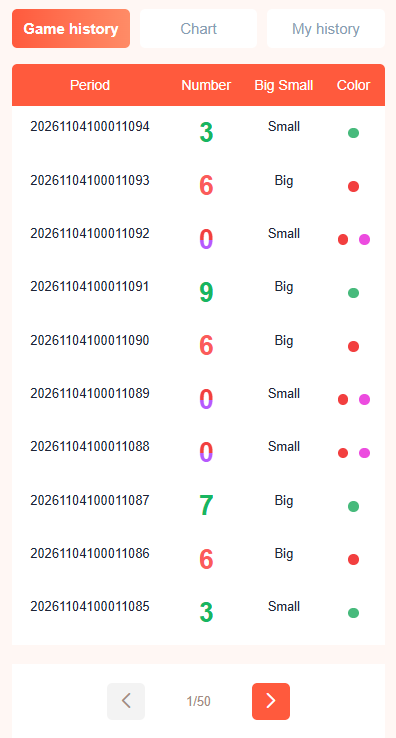
The first two rows illustrate the reading process:
- The first row’s number is 3. The same row labels it Small and shows a Green dot.
- The next row’s number is 6. That row labels it Big and shows a Red dot.
A period is an identifier for the displayed round. It is not a probability score. When comparing a chosen number with a later outcome, check that both refer to the intended room and round. Do not compare one period’s choice with another period’s result.
Pagination changes which history rows are visible. A page of ten rows should not be treated as the complete history or automatically as a random sample. Before calculating a percentage, record how many results you counted and what range they cover.
Reading the DmPlay number chart
The Chart reference displays digits 0–9 on each result row, highlights the result’s position, and connects the selected positions. A size marker at the side summarizes Big or Small for that row.
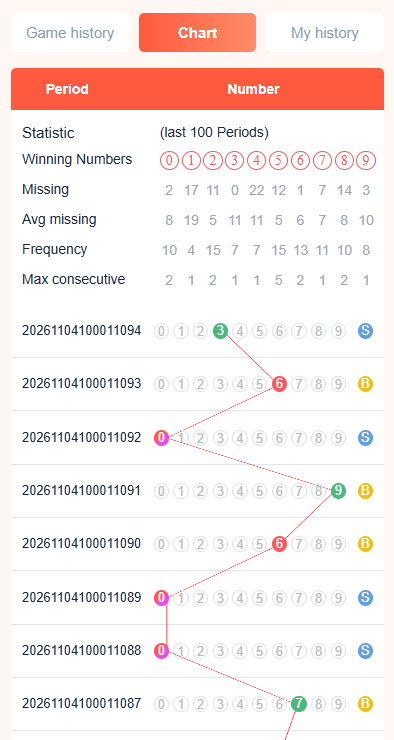
Start with the period, find the highlighted digit, then compare its size marker with the classification table. Look at the row order before describing an increase, decrease, or streak: reading latest-first history from top to bottom moves backward through the displayed sequence.
The statistics panel names a window of the last 100 periods. Its frequency and missing-count fields summarize that window. We have not verified the external platform’s exact formula for every field, including “Avg missing”; a familiar label is not enough to establish its implementation. Our own history-analysis guide defines the counts and denominators used in the lab instead.
The line may look like a slope, zigzag, or repeating shape. Digits are categories of outcomes, and the line joins their positions in a chosen layout. Its geometry does not prove a mechanism that will produce the next digit.
A practical observation exercise
You can complete this exercise with the supplied reference table or the local WinGo simulator:
- Write down the room or dataset, the draw identifier, and the number of rows you will inspect.
- Read five consecutive outcomes. Label each number’s size and all of its colors.
- Count Big and Small using five as the denominator. Count Red, Green, and Violet separately because their memberships overlap.
- If you made a guess before a result, record both the guess and the result without omitting non-matches.
- Describe the observation without presenting a match or a streak as proof of prediction.
For a constructed example, 3, 6, 0, 9, 5 contains two Small outcomes and three Big outcomes. Three results have Green membership, two have Red membership, and two have Violet membership. The color counts total seven memberships across five results because 0 and 5 each belong to two groups.
This example is a teaching sequence, not a claim about the next DmPlay round. Use the probability calculator to explore questions under the lab’s explicitly uniform, independent model.
Does a matching guess validate a prediction method?
One matching guess is an observation. It is not enough to establish a reliable method or an advantage. A meaningful evaluation would need predictions recorded before outcomes, a defined baseline, a suitable sample, and a process that includes all failures as well as matches.
Under the lab’s independent model, a run of Small outcomes does not make Big due. Nor does a digit’s absence from a short history establish that it must appear next. Read patterns and randomness for the distinction between describing a streak and predicting an independent draw.
Is this a verified DmPlay demo account guide?
No. We have not verified a dedicated demo-only route or confirmed that external registration leads to a no-deposit, virtual-credit-only mode. A displayed chart, registration page, or visible account balance does not establish that status.
Our local simulator is available without an external account and generates clearly labeled synthetic outcomes. It is the appropriate place to practice the classifications and probability exercises described on this site without treating external results as verified data.

